
Searching for John - Part 1
An epic journey to uncover and honor the legacy of my great uncle

“Wait, who is John?” I asked, almost forgetting I was pouring wine and spilling it all over the floor.
My family was sitting around the dinner table on Christmas, doing what families often do – telling old stories of odd relatives. Now, I love a good tale from years past, and there were some juicy ones in there, but this was a name I had never heard before. My mom went on to explain that John was her dad’s brother – the golden boy of the family who was a popular jock in high school and the only one of the siblings who went off to college. Not only that, but he was a flyboy, part of the famed Army Air Corps during World War II. She mentioned that he had lived on Cape Cod for the last 40+ years of his life, only 3 hours from where I grew up. How did I not know about this guy? As my mom continued to share what little she knew of him, my interest only grew. I had so many questions, none of which anyone could answer.
“He was part of a B-17 crew?
“Was he a pilot?”
“What? He was shot down? Where?”
“What happened to him?”
I fired off question after question, only to grow frustrated by the lack of information people had. It turns out that John sort of disappeared more and more after he returned from the war and eventually lost touch entirely. The little that I learned was that he was shot down, became a POW held by the Germans, and, according to my grandmother, he returned from the war emaciated and without color in his eyes for 6 months. Beyond those brutal details, there was little else.
It was right around this time that I was really getting into researching my family’s WWII history. While I had always had a tangential interest in it, most everything stayed on the periphery. But after looking through a wartime scrapbook of my grandfather’s, affectionately known as Pop Pop, my passion began to take hold.
The pictures were astonishing – his days training with the 414th Field Artillery of the 20th Armored Division at Camp Campbell, Kentucky; his time traversing France and Belgium; and his first experience of combat in Germany. There are photos of Hitler’s bombed-out home in Berchtesgaden, him sitting in Goering’s captured personal plane, and, shockingly, the horrors his division found at the Dachau concentration camp. Pop Pop had kept this book secret for 50+ years, but as I sat there looking at it, the gravity of what he and so many of his fellow soldiers endured took on added weight. I kept wondering what other family members experienced and how they fared during and after the war. This new guy, John McDonough – what did he go through? Who was he? And how on earth do I find out?
I spent a lot of time lost in thought over the next few weeks, trying to imagine what it must have been like for John both during the war and when he got home. I ended up asking my brother a few follow-up questions, but got the same response – “I don’t know.” What gnawed at me most during this period was that John’s story and legacy seemed to have been wiped from history. This young guy, who faced the worst of what war had to offer, survived and returned home, only to be forgotten. With my curiosity now at a DEFCON 1 level, I sat down one morning at my laptop, pad and pen at the ready, and started digging.
There were a lot of John McDonoughs. My mom comes from a big Irish Catholic family in New Jersey, so their names were what you would expect: John, Sean, Brian, Kevin, George, Jane, etc. While I understand and respect the tradition, it makes internet searches of an obscure WWII veteran really hard. And as a novice researcher, the constant dead ends I ran into made me want to throw my computer out of a B-17 bomb bay door at 25,000 feet. Not knowing what steps to take next, I did what anyone would: I spent a small fortune on membership fees for a half dozen research and ancestry services. I had rarely used any of these before, and sifting through 80-year-old documents while not knowing what I was even looking for was getting old. I needed more basic information, so I grabbed my phone and texted the expert.
Brian: “What was John’s middle name?”
Mom: “John who?”
Brian: “Oh, sorry. Your uncle, John McDonough.”
Mom: “I have no idea. Why?”
Brian: “What about his birthdate?”
Mom: “Don’t know. What is this about?”
Brian: “Oh. Well, do you know where he was born?”
Mom: “Newark, NJ, I think. Brian, what is this about?”
Brian: “Do you know his wife’s name?”
Mom: “BRIAN!”
Brian: “Haha, sorry! I am trying to find information about John’s time in the war, and am struggling, but Newark will do. Thanks!”
My asking endless questions was common in my household growing up, so this exchange was par for the course. While hoping for more, his hometown was better than nothing. It also reiterated the fact that John was truly an unknown, and I was determined to change that. With this new morsel of information, I went to work.
Finding dozens of John McDonoughs from New Jersey who were of fighting age during WWII, I scrolled until one draft card popped up that piqued my interest. The distinct faded manila color, with its mix of print and handwriting, was typical, but one detail stood out. It was time for a bit more bothering…
Brian: “Mom…sorry…just one more question.”
Mom: “OK.”
Brian: “Wasn’t your grandma’s name Helen?”
Mom: “Yes.”
Brian: “LET’S GO!”
Mom: “Where?”
Brian: “What? No, sorry. I’m just excited. Thanks, mom!”
And just like that, pieces of John started to come to life. I studied the card, John’s own handwriting in neat cursive, filling out the lines.
John Francis McDonough, born on March 19, 1921, the son of George and Helen, with blonde hair and blue eyes.
He did exist; he had a life.
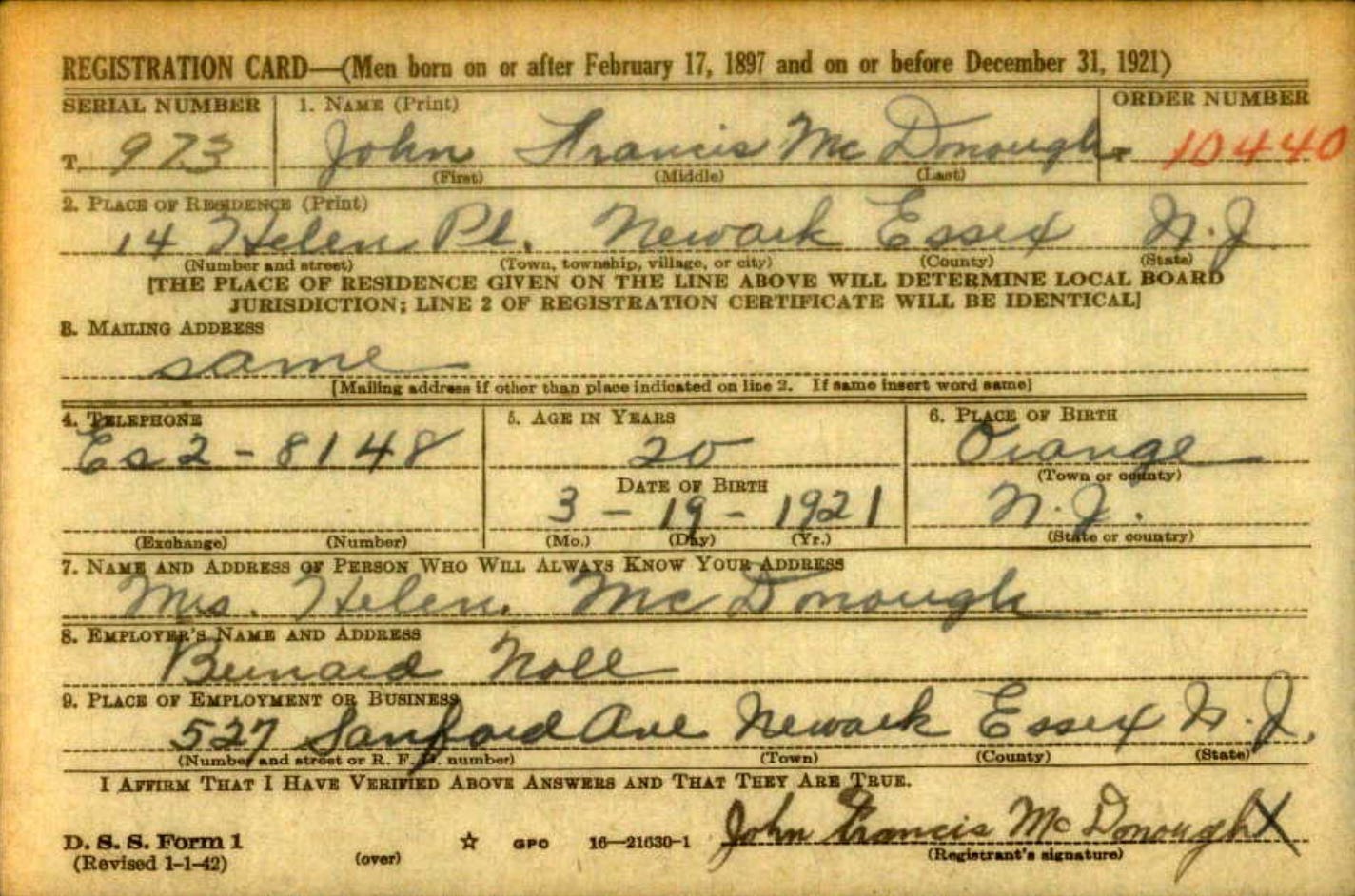
I wondered what he was like when he was filling out his card, well before the horrors that he experienced. Was he as excited and full of determination to defend his country as so many men his age were? What did he do in the war and end up experiencing? How did war change him? While the draft card was just a little piece, it added to a determination in me that was taking firm hold.
Now that I had a little lead, I fired up Google and entered his full name, his home state, and the Army Air Corps. Scrolling through the results, I saw him: a profile linked to www.100thbg.com – the 100th Bomb Group Foundation. Clicking the link excitedly, the page flickered to life, and those blue eyes were staring right back at me.
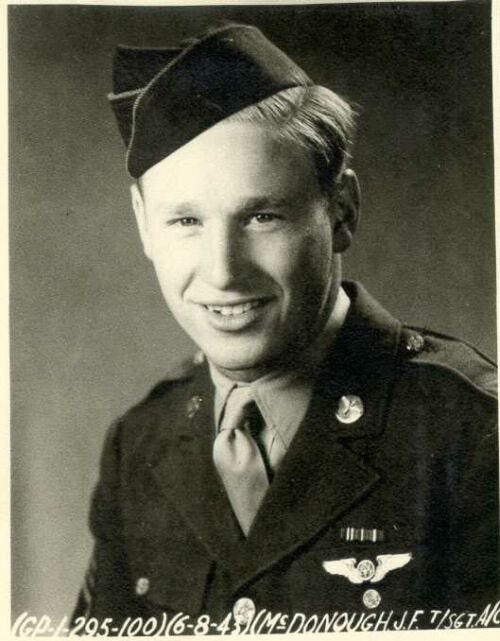
There he was, an unmistakable McDonough face, in full uniform, hat tilted slightly to the side of a part in his hair. “He looks happy,” I thought as my own smile started to form. As I scrolled, details that I thought were lost to history began to emerge.
“T/SGT John F. McDonough, TTE, 349TH Bombardment Squadron, Jack Justice Crew of the Pasadena Nena.”
“This is amazing, but what the hell is a TTE and who is Jack Justice?” I said out loud as I furiously wrote down as many details as I could find. “Top turret gunner and engineer? So, John was the real deal.” My conversation with myself continued as John’s biography slowly filled in. I spent the next few hours scouring the 100th Bomb Group Foundation’s website, reading all the details about him and staring at his crew photo in front of Pasadena Nena, which I found to be an awesome name for a plane, even though I had no idea what it referred to.
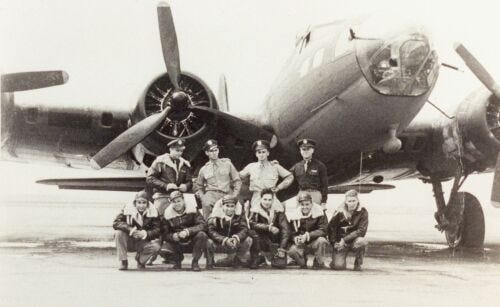
In reading the crew’s bios, I uncovered that while John and seven others safely bailed out, two others were killed. Looking for more details, I realized that Jack Justice was the lead pilot, and while the others became POWs, he had an evasion story that read like a Hollywood script. The information was overwhelming - after fighting so hard to find even the most minute details about John, I was now being inundated with a flood of history.
After a while, I looked up and realized a good 6 hours had passed, and I hadn’t moved an inch. Putting the pen and paper down, I texted my mom and brother to let them know what I had learned and sent photos of John in his uniform and of the whole Pasadena Nena crew. While my head was spinning with all the new information, faces, and names, a familiar thought kept popping up — I need to learn more.
While shoveling the first meal of the day into my mouth at 6 PM, I searched Google for references to the Münster mission, as this was the one John and his crew went down on. As I read, it became clear that John, and every single man from the 100th that made it over Germany, faced hell in the skies on October 10, 1943. The facts were astounding – 12 out of 13 B-17s from the group failed to return, 120 men were lost, and only the 10-man crew of the badly damaged Royal Flush made it back to the runway at Thorpe Abbotts. So many young men woke up safely in their beds in the UK that morning, only to never return. Two of them, S/Sgt Gaetano Sportelli and 2nd Lt. John Shields of the Pasadena Nena, didn’t survive the day. Top Turret Gunner and Flight Engineer, John McDonough, on his 17th combat mission, was on the ground in enemy territory.
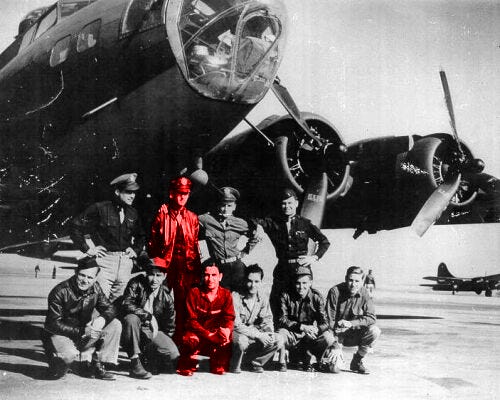
My thoughts went to John and the terror he must have experienced. I couldn’t fathom the pain and trauma he must have carried for the rest of his life. Reading pilot Jack Justice’s account of what happened that day truly hammered things home. Describing the desperate scene inside the cockpit as the pilots battled to control the crippled plane while the rest of the crew bailed out over the Netherlands: “We counted seven chutes, and John [co-pilot John Shields] tried to stop the engineer from going out the bomb bay, but he could not hear him and abandoned the aircraft.”
The engineer—my great uncle, my family—jumped out of a burning plane towards an unknown fate.
It was in that quiet moment in my kitchen that I knew I had to follow this new path I had opened up in my life. John McDonough endured horrors I couldn’t begin to fathom. And yet this heroism—his legacy—was not captured in a scrapbook of photos to flip through, or through stories passed down for loved ones to share. And, therefore, forgotten. That was unacceptable to me. Maybe I’ll be the only one who cares about bringing this man back to life, but whatever – I was going to do it.
--
Lying in bed that night, I was haunted by my grandmother’s description of John when he got home from the war. “He had no color in his eyes for six months—they were just gray.” What had he seen? What had he experienced that drained the literal light out of his eyes? Unable to sleep, I got up, opened my laptop, and the screen light kicked my brain into focus. It didn’t take long to find what I was looking for.
“John F. McDonough, 88, of South Yarmouth, died on July 17, 2009. He is survived by his wife of 61 years…”
There he was, in the Cape Cod Times, more record of a life lived. But even in the obituary, his legacy was lost; it was a mere 4 sentences long, not a word about his wartime service. Astonished, I scrolled down past the ads to see if I was missing anything. Sadly, the only thing left were three comments from people expressing their condolences. Focusing on the longest one, it said John had a tough final two years, which broke my heart even more. The name of the commenter, though, was what I was drawn to most – the last name was very unique. Whether it was due to exhaustion from being awake and scrolling through old obituaries at 2 AM or just a new obsession taking further hold, I entered that name into a Facebook search and got a hit.
“I mean, is this crazy? No…well, OK…yeah, definitely a little bit. She won’t mind…right?” I began talking to myself as I was staring at the message box. Who tracks down a random stranger in the middle of the night on social media after finding their name in the condolence section of an obscure obituary about your long-lost relative?
I do, I guess.
After staring for a while at the blinking cursor at the end of my question on Facebook Messenger, I let my finger drop and hit enter. Pushing my chair back as if I had just done something wrong, I read my words over:
“This may seem out of the blue, but I was wondering if you knew John McDonough?”
I woke up the next morning much later than usual – a consequence of scouring the ends of the internet for the traces of a man that history seemingly didn’t want to be found. With a big stretch, I sat down where I had been just a few hours before, back at my trusty computer, where the footsteps of John’s legacy waited to be followed – or so I hoped. I flipped the screen open, the browser still in the same spot as I left it. Only this time, there was a little red notification on the messenger icon in the upper-right corner. I sat up straight and held my arms out as if I was trying to stop time for a brief second to process what this could mean. “Holy ****… is it her?” I said out loud, as if anyone else on the planet could possibly know the answer. Tracing my finger on the mouse trackpad, I clicked on the message and held my breath.
“Hi, Brian. Thank you for reaching out to me. Your grand uncle, John, and his wife Marj, were neighbors of my husband and me for over twenty years…John was a very quiet person all the time we knew him, and did not talk about his war experiences. According to Marj, it was much too difficult, and his memories continued to haunt him until he died.”
I don’t think I exhaled for several minutes. John’s neighbor went on to say that he was a big golfer and enjoyed going to the course with his buddies, even playing 364 days a year – the club was closed on Christmas. I was grinning, as I am a big golfer, too. But all those were fading footnotes in the moment. John, the popular jock in high school, who smiled so brightly in his military service photo, barely spoke. He was ravaged by what he experienced in the war for 60+ years of his life.
A man lost.
I began to tear up a bit as I grabbed my phone off the nightstand in my bedroom. Clicking the familiar name, I waited for her to pick up.
“Hey, Mom,” I said, my voice cracking a little bit. “I think I need to go to Europe. I need to go find John.”
--
To Be Continued
This essay appears in the most recent edition of Splasher Six, the 100th Bomb Group Foundation’s official newsletter. Many thanks to Nancy Putnam for your encouragement, patience, and edits.
Really enjoyed reading this. You can tell how much time and effort you’ve put into tracking everything down—it doesn’t feel like just research, it feels personal. That kind of dedication is what makes these stories actually matter.
I connected with this a lot because I’m working on something similar myself. I started digging into my great grandfather’s service, and it’s kind of turned into trying to piece together his entire B-24 crew and what they went through in the CBI. It’s not the easiest theater to research—there’s just not as much out there compared to Europe—but that’s also what’s pulled me into it more.
I’ve been focusing on the 308th Bomb Group, specifically the 373rd Bombardment Squadron, and the deeper I get, the more it feels like there’s a lot of their story that hasn’t really been fully told yet. I’m hoping to help change that in some small way.
Anyway, just wanted to say I respect the work you’re doing here. Looking forward to the next part.
You just gained a follower Brian! Dont stop with John, there are many more lost stories out there for us to bring to light! If you ever wanted to connect feel free to reach out.
Chris